Introduction
With thousands of commuters riding the country’s Light Rail Transit Line 1 and Line 2 daily, there is no doubt that these transportation hubs are prime locations for advertising your brand. But identifying transit stations as placement locations isn’t enough; you need to ensure that this promising ridership volume actually notices your brand’s message.
To help, Outcomm explains how you can design advertising assets at LRT stations in the Philippines that will catch your target audience’s attention. Read on to start your campaign on the right foot.
Why You Need To Learn How To Properly Design LRT Ads
While LRT has a high ridership, thus a promising captive audience, plenty of factors can cause them to miss your advertisements. Your message competes with people’s emotions and preoccupations. Often, many are too tired to look around, while several others are glued to their phone screens. With these many distractions, launching an effective LRT advertising campaign can be quite the challenge.
That’s why good design is a must. You would want to cut through people’s internal noise and external distractions to at least capture their attention. Once you hold that attention, the likelihood that your ad improves brand awareness, visibility, and recall increases.
In a way, LRT ads need to be catchy even at a glance while also packed with a clear message to keep your audience curious and engaged, or, better, to prompt them to take action.
Advertising Design Tips To Attract LRT Station’s High Ridership
You need great design to capture your people’s attention within a few seconds and hold it for a few more to relay your message. To help you get started, below are tips for creating LRT station advertising assets that resonate with the Philippine audience.
Identify a Common Interest or Pain Point
Before thinking about color palettes, layouts, or ad copy, you should identify what matters to LRT commuters. Are they concerned about saving time? Or looking for affordable meals near the station? Are they interested in mobile promos? Are they curious about financial services? Are they planning to spend on lifestyle upgrades?
That said, there are too many concerns out there that you can’t hope to address them all. So, revisit your brand’s solutions and unique selling points, then align them with the common interests or pain points of LRT riders. You don’t even need to be specific — identifying riders’ demographics would be enough.
When your LRT ad reflects a real commuter need, such as convenience, savings, or self-improvement, you immediately establish relevance. The messages you build from that create strong connections, in turn establishing familiarity and trust with your target market.
Choose an Effective Advertising Technique
Beyond ensuring ad relevance, you need to employ several persuasion techniques to strengthen message retention and encourage action. When you select the right approach, your LRT ads don’t just crowd stations; they stand out.
If you want to maximize the cost of putting up LRT ads, consider the following advertising approaches:
Appeal to Emotion
Emotional resonance encourages deeper brand recall in your target audience, which you can achieve through relatable storytelling. For instance, creating an ad that shows a hardworking corporate employee achieving a goal despite the odds can resonate with the commuting public. The more lived and realistic the storytelling, the more likely the ad is to leave a lasting impact.
Bandwagon
Highlighting popularity can influence brand perception. Phrases like “Join thousands of commuters who switched” subtly signal trustworthiness and nudge your target audience to jump on the bandwagon themselves. When passengers believe others like them have already made the choice, their hesitation decreases, and they become easier to convince.
Social Proof
People trust brands when they can see testimonials, ratings, or short endorsements from ordinary people or credible personalities. Incorporating a quick review snippet or a trust badge into your ad is an effective way to hold your captive audience’s interest. Moreover, it can make them curious enough to try the product or service themselves to prove the review!
Influencers
Featuring a recognizable personality can make your ad stand out. Research trending personalities on social media platforms to choose which influencer best aligns with your brand and with LRT’s demographics, then propose an agreement to have them advertise your products and services. For instance, TikTok influencers will likely pique LRT’s high volume of student riders; if you have a product that caters to this demographic, look for an influencer that aligns with your vision.
Unfinished Ad
If you don’t want to cram your ad space with too much copy, cutting off the message works just as well. You can leverage curiosity by creating an unfinished ad that ends with a clear CTA. For example, a teaser headline that says “This product offers the best…” followed by a CTA to scan a QR code so viewers can read the rest of the copy.
Promotions and Rewards
Limited-time offers are effective in catching people’s attention. Ensure that you can communicate clear discounts, exclusive commuter deals, or rewards programs at a glance, so that even commuters in a hurry will stop just enough to scan a QR code or snap a picture of your ad for later perusal.
Present a Clear, Concise Message
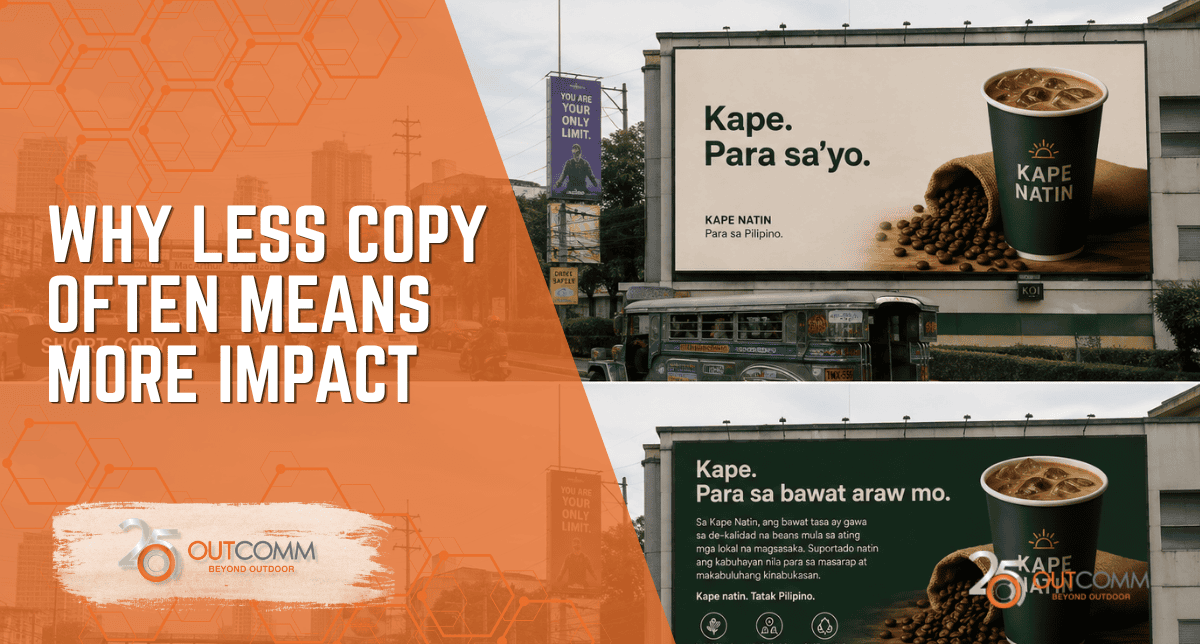
Passengers often see train ads in motion, or while walking, so your ad copy should be readable within seconds. Be sure to focus on one core message and pair it with strong, relevant visuals to communicate it quickly.
A quick tip for crafting a clear, concise message is to focus on benefit-driven statements rather than lengthy explanations. For example, “Save 20% Every Payday” is more powerful than a paragraph describing a product’s features (even when you are actually promoting the new product).
Leverage Best Practices in Graphic Design
Strong visuals enhance visibility in crowded stations, so be sure to apply fundamental design principles to make your ad readable and memorable.
Color Palette
Use bold, contrasting colors that stand out against station architecture. Avoid shades that blend into common backgrounds such as gray, white, or metallic surfaces, and ensure brand consistency while maintaining strong visibility from a distance.
Typography
Select fonts that are legible even when viewed from several meters away. For instance, sans-serif fonts often perform better in transit environments. Also, limit font styles to two at most to maintain clarity.
Hierarchy of Elements
Arrange your ad content so the eye naturally flows from the headline to the visual to the CTA. The most important message should be the largest and most prominent, while supporting information should remain secondary.
Include a Clear CTA
Every LRT campaign should guide commuters toward a specific action. Whether scanning a QR code, visiting a website, or redeeming a promo, your CTA must be clear and easy to read. Remember to position the CTA so it’s easily noticed without disrupting the overall design.
Conclusion
Effective LRT station advertising in the Philippines involves a deep understanding of your audience, strategic messaging, and disciplined design execution. When aligned with commuter behavior and station environments, your campaign transforms high ridership into measurable brand impact.
If you are ready to elevate your transit advertising strategy, Outcomm offers prime LRT and MRT ad placements tailored to your objectives. Contact us to explore your options!